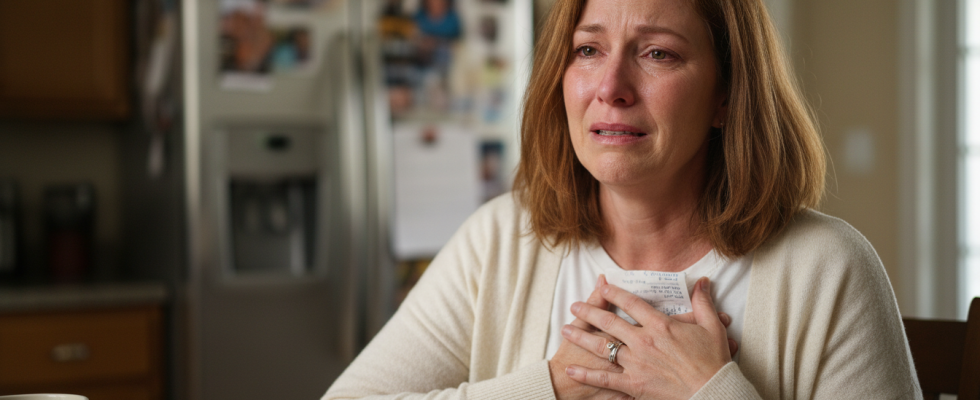
Margaret Thompson had been a widow for six months, but some mornings she still woke up expecting to find her husband David sleeping beside her. The sudden nature of his death—a massive heart attack at age 52 while mowing the lawn on a sunny Thursday afternoon—had left her in a state of suspended disbelief. One moment he’d been alive, waving at her through the kitchen window. The next, he was gone.
They’d been married for 28 years, and Margaret had spent the months since his death moving through life in a fog. Their two adult children, Emily and Jason, had been supportive, visiting often, helping with paperwork and funeral arrangements. But eventually, life moved forward for everyone else while Margaret felt stuck in the moment she’d looked out the window and seen David collapsed on the grass.
On a Tuesday morning in early November, Margaret decided it was finally time to tackle one of the tasks she’d been avoiding: cleaning out the kitchen junk drawer. It was a chaotic mess of rubber bands, old receipts, batteries, twist ties, and scraps of paper with phone numbers. David had always stuffed things in there—receipts from the hardware store, notes about car maintenance, reminders about household repairs he intended to get to someday.
Margaret pulled everything out and spread it across the kitchen table, sorting items into piles: trash, keep, unsure. Most of it was garbage—expired coupons from 2019, receipts from restaurants they’d visited years ago, broken pens that no longer worked. She was nearly finished when she found a crumpled grocery store receipt wedged in the very back corner of the drawer, partially hidden under an old instruction manual for a blender they no longer owned.
The receipt was from Riverside Market, dated March 14th—exactly two weeks before David died. Margaret almost threw it in the trash pile without reading it. What did it matter what groceries he’d bought six months ago? But something made her pause. Maybe it was the fact that the receipt was more crumpled than the others, as if David had handled it multiple times. Maybe it was simple curiosity. Whatever the reason, Margaret smoothed out the wrinkled paper and began reading the items listed.
Her hands started trembling as she read down the list. The items weren’t random grocery purchases. They were specific, deliberate, meaningful: Costa Rican coffee beans from the specialty brand they’d discovered on their honeymoon 28 years ago but could never find in local stores; imported Italian pasta—the exact type they’d had at a small restaurant in Rome during their 25th anniversary trip; vanilla extract; heavy cream; fresh basil; pine nuts; parmesan cheese; and a small bunch of purple tulips, her absolute favorite flower that David bought her every year on their anniversary.
Margaret’s heart began racing as the significance of these items hit her. These weren’t random purchases. These were ingredients and items from their most important memories together. The coffee from their honeymoon. The pasta from their anniversary in Italy. The tulips he always gave her. But why had he bought all of this on March 14th? What was he planning?
Then Margaret saw something that made her breath catch in her throat. At the bottom of the receipt, in David’s familiar handwriting, was a note: “Practice dinner—surprise for Saturday. Called Mike—he’s in. Don’t forget candles!!!”
Margaret’s mind raced as she counted back the dates. March 14th was a Tuesday. The Saturday after that would have been March 19th. She grabbed her phone and pulled up the calendar. March 19th would have been their 28th wedding anniversary—a date they’d never gotten to celebrate because David had died on March 17th, just two days before.
Tears began streaming down Margaret’s face as she realized what this meant. David had been planning to cook her a special anniversary dinner, recreating dishes from their most cherished memories together. He’d been practicing. He’d even enlisted help from someone—someone named Mike. And he’d been excited about it, excited enough to leave himself notes and reminders.
Margaret clutched the receipt to her chest and sobbed. Her husband had died planning something beautiful for her. He’d been thinking about their anniversary, about making her happy, about celebrating their life together. And she’d never known. She’d never gotten to experience it. The surprise had died with him.
But then another thought struck her. Who was Mike? David had several friends named Mike, but which one had he called? And what did “he’s in” mean? Was Mike supposed to help with the dinner somehow? Was there more to the plan that Margaret didn’t know about?
With shaking hands, Margaret picked up her phone. David’s best friend since college was Mike Harrison, a man who lived three hours away in Portland but who had been at David’s funeral, delivering a eulogy that had made everyone cry. Margaret hadn’t spoken to Mike since that day—it had been too painful to talk to David’s closest friend, someone who reminded her so much of her husband.
But now she needed to know. She found Mike’s number in her contacts and pressed call before she could change her mind. The phone rang four times, and Margaret almost hung up, but then Mike’s familiar voice answered: “Margaret? Is everything okay?”
Margaret’s voice broke as she tried to speak. “Mike, I… I found something. A receipt. From before David died. He wrote your name on it and said you were ‘in’ on something. What was he planning? Please, I need to know.”
There was a long pause on the other end of the line. Then Mike’s voice came back, thick with emotion. “Oh God, Margaret. He made me promise not to tell you unless… unless something happened to him. He wanted it to be a surprise. But I think you need to know now. Can I come see you? This isn’t something I can explain over the phone.”
Three hours later, Mike Harrison sat at Margaret’s kitchen table, the crumpled receipt between them. He had tears in his eyes as he began to explain.
“David called me about two months before he died,” Mike started. “He said he wanted to do something special for your 28th anniversary. Something bigger than just dinner. He’d been planning it for over a year, Margaret. He’d been setting money aside, making arrangements, coordinating with people.”
Mike pulled out his phone and showed Margaret a series of emails and text messages between him and David. As Margaret read them, the full picture of David’s plan began to emerge, and she could barely see through her tears.
David had been planning a two-week trip to Italy for their anniversary—not just any trip, but a recreation of their 25th anniversary vacation, visiting all the same places they’d been three years earlier. He’d already booked the flights, reserved the same hotel rooms, even made reservations at the same restaurants. Mike had been helping him coordinate everything, serving as the secret keeper and logistics coordinator.
But David had wanted to do more than just recreate their anniversary trip. He’d planned to spend the six months leading up to it practicing cooking all of Margaret’s favorite meals—the special dishes they’d discovered during their travels together. The pasta from Italy, the coffee from Costa Rica, recipes from France and Spain and Greece. He wanted to cook her one special dinner each month, building up to the big anniversary surprise.
“He was so excited, Margaret,” Mike said, his voice breaking. “He called me after every practice dinner he cooked, telling me what worked and what didn’t. He was like a kid, so happy to be planning this surprise for you. He said you’d been through so much together—raising the kids, his job stress, your mom’s illness—and he wanted to remind you why you fell in love in the first place.”
Mike handed Margaret a folder he’d brought with him. Inside were printouts of all the emails, copies of the flight confirmations, hotel reservations, restaurant bookings—all dated for late March and early April, weeks that had come and gone while Margaret was drowning in grief, not knowing that David had planned to whisk her away to Italy.
But there was more. At the bottom of the folder was a letter, sealed in an envelope with Margaret’s name on it in David’s handwriting. Mike’s hands trembled as he gave it to her.
“He wrote this and gave it to me for safekeeping,” Mike explained. “He said it was in case something happened to him before the anniversary. He was always worried about his heart—his dad died young of a heart attack too. He wanted to make sure that if he didn’t get to give you the trip, you’d at least know how much he loved you.”
Margaret opened the envelope with shaking hands and pulled out several pages of paper filled with David’s familiar handwriting. Through her tears, she began to read:
“My dearest Margaret, if you’re reading this, it means I didn’t get to give you the anniversary surprise I’ve been planning, and I’m so sorry for that. I’m sorry for any pain I’ve caused you by leaving. I’m sorry I won’t be there to grow old with you like we planned. But I need you to know that every single day of our 28 years together has been the greatest gift of my life…”
The letter went on for pages. David wrote about their first date, their wedding day, the birth of their children, and dozens of small moments he’d treasured throughout their marriage. He wrote about why he’d chosen each destination and each meal for his surprise plan—every location held a specific memory, every dish represented a moment when they’d been truly happy together.
He wrote about the future he’d hoped they’d have—retirement trips, grandchildren, growing old together in the house they’d bought when they were young and broke. He wrote about his fears that his heart might give out like his father’s had, and his determination to make every moment count while he still could.
And he ended with instructions. If something happened to him, he wanted Margaret to take the trip anyway. He’d paid for everything already. Mike had all the details. David wanted her to go to Italy, to visit those special places, to remember the love they’d shared and to keep living, to find joy again even in his absence.
“Please don’t let my death be the end of your story,” David had written. “You have so much life left to live, so much love left to give. Take the trip. Eat the food. Drink the wine. Remember us at our best. And then come home and keep living. Promise me, Margaret. Promise me you’ll keep living.”
Margaret sat at her kitchen table and cried harder than she had since the day David died. But these tears were different. They weren’t just grief—they were also gratitude, love, and a bittersweet kind of joy. Her husband had loved her so much that even in death, he was still taking care of her, still planning for her happiness.
Mike stayed with Margaret for hours that day, showing her photos on his phone that David had sent him during his practice cooking sessions. There was David in the kitchen, wearing the apron Margaret had bought him for Christmas, grinning proudly at a pot of pasta. There he was holding up purple tulips, texting Mike: “Got her favorites—she’s going to love this.” There were screenshots of recipes he’d researched, notes about what wines to pair with each course, even a playlist he’d created of songs from different periods of their relationship.
Before Mike left that evening, he handed Margaret one more thing: an envelope containing two plane tickets to Rome, departing in two weeks. “He bought these back in January,” Mike explained. “Non-refundable, non-transferable. They’re in both your names. The trip is already paid for, Margaret. Everything is already arranged. Emily and Jason know about it—David told them before he died, swore them to secrecy. They want you to go. We all want you to go.”
Margaret stared at the tickets, overwhelmed. “I can’t go alone,” she whispered. “I can’t go to all those places without him.”
“You won’t be alone,” Mike said gently. “David arranged for Emily to go with you. The hotel rooms have two beds. He wanted you to have this experience with someone you love, someone who would understand. Emily has already requested the time off work. She’s waiting for you to say yes.”
Two weeks later, Margaret and her daughter Emily boarded a plane to Rome. Margaret carried David’s letter with her, folded carefully in her purse along with that crumpled grocery receipt. The trip was everything David had planned—they visited the same restaurants, stayed in the same hotels, walked the same streets they’d walked three years earlier when David was alive and their anniversary had been full of joy instead of grief.
But this trip was different too. It was a journey of remembering and healing. At each restaurant, Margaret and Emily would order David’s favorite dishes and raise a glass of wine to him. They cried together, laughed together, and shared memories of the man they both loved. Emily told her mother stories about conversations she’d had with her father before he died—how excited he’d been about the surprise, how he’d sworn her to secrecy, how he’d planned every detail with such care.
On what would have been their anniversary night, Margaret and Emily sat at the same small outdoor restaurant where Margaret and David had eaten on their 25th anniversary. Margaret ordered the pasta David had bought ingredients to practice making—the dish that had been on that grocery receipt. When it arrived, she took a bite and closed her eyes, remembering David in their kitchen, trying to recreate this exact flavor, wanting so badly to make her happy.
“He loved you so much, Mom,” Emily said softly, watching her mother cry. “He wanted you to know that. Even if he couldn’t be here to show you, he wanted you to know.”
Margaret nodded, unable to speak. She knew. The receipt had told her. The letter had told her. This trip had told her. David’s love hadn’t ended with his death—it had been woven into every plan he made, every surprise he tried to create, every moment he’d spent trying to make her life more beautiful.
When Margaret returned home from Italy, she felt different. The grief was still there—it would always be there—but it was accompanied now by something else: gratitude. She had been loved deeply and completely. She had been married to a man who spent his last months on earth planning ways to make her smile. That was a gift, even if the gift had come with heartbreak.
Margaret framed that grocery receipt and hung it in her kitchen, along with a photo from their Italy trip—a picture Emily had taken of Margaret raising a glass of wine in a toast to David. Underneath the frame, she placed a small card with David’s words from his letter: “Keep living. Promise me you’ll keep living.”
And she did. Margaret kept living. She traveled more, spending time with Emily and Jason and eventually her grandchildren. She took a cooking class and learned to make the dishes David had been practicing in their kitchen. She planted purple tulips in her garden every spring. She even started a blog about marriage and loss and the unexpected ways love continues even after death, sharing the story of the grocery receipt and David’s surprise.
The blog reached thousands of people—widows and widowers who understood her grief, couples who were inspired to appreciate the time they had together, people who needed to hear that love doesn’t end at death. Margaret received messages from around the world from people who said her story had changed them, had made them hug their spouses tighter, had reminded them not to take a single day for granted.
Mike Harrison remained a close friend, visiting often and sharing memories of David. He told Margaret that he believed David would be proud of her, proud of how she’d honored his memory by continuing to live fully and joyfully despite her grief.
Years later, when Margaret’s granddaughter asked her what the framed receipt in the kitchen meant, Margaret took her on her lap and told her the story. She told her about a man who loved his wife so much that he spent his last days planning a surprise he would never get to give. She told her about grief and gratitude, about finding joy in sorrow, about the ways love echoes forward even when the person who loved you is gone.
“Your grandfather taught me something important,” Margaret told her granddaughter. “He taught me that love isn’t just about the time you have together. It’s about what you do with that time. It’s about the plans you make, the effort you put in, the ways you try to make the people you love feel cherished. Even though he’s gone, I still feel loved every single day because of what he left behind—not just things, but memories and lessons and reminders that I mattered to him.”
The crumpled grocery receipt stayed in its frame, a testament to love that continued beyond death. Those simple items—coffee, pasta, tulips, ingredients for a dinner that never happened—had become symbols of something much bigger: a man’s devotion to his wife, a plan that unfolded even in his absence, and a reminder that sometimes the most ordinary objects can carry the most extraordinary love stories.
And every year on March 19th, their anniversary, Margaret would make the pasta David had been practicing, brew the Costa Rican coffee, and place purple tulips on the table. She would read his letter again, and she would remember. She would remember the man who loved her enough to plan surprises he might never get to give. She would remember the grocery receipt that changed everything. And she would keep her promise to him—she would keep living, keep loving, keep finding joy in the life he had wanted so badly for her to have.
