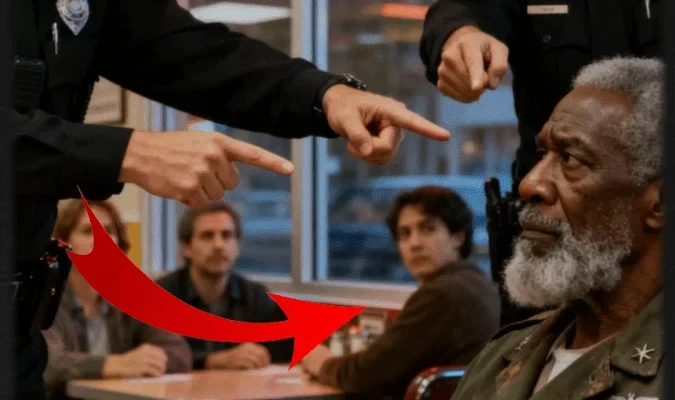
The morning rush at Millbrook Diner had just begun when two police officers stepped inside, their boots tapping across the checkered floor. Conversations quieted as the officers scanned the room, their attention settling on a man sitting alone in the corner booth. His jacket was worn, his posture tired, and the fading tattoo of an American flag on his arm peeked out from beneath his sleeve.
To most people, he was simply another quiet patron seeking a warm cup of coffee. But to the officers, his appearance raised concerns. One nudged the other and whispered a remark about him “lingering too long.” The man didn’t respond. He lifted his cup calmly, as though he had experienced this kind of scrutiny many times before.
His name was Malik Carter, a veteran who had served two tours overseas and spent more than a decade supporting specialized operations. After returning home, life had become unexpectedly difficult. Complicated paperwork, health issues, and personal setbacks had pushed him into homelessness. Still, he carried himself with quiet dignity, never causing trouble, never asking for special treatment.
“Sir, do you have identification?” one officer asked, leaning over his table. The tone was firm but not aggressive—more impatient than anything else.
Malik set down his cup. “I’m just finishing my coffee,” he replied respectfully.
“We’ve had complaints about disturbances in the area,” the officer continued. “We need you to step outside for a moment.”
A few customers watched uneasily. Malik’s shoulders lifted in a slow breath. He had encountered misunderstandings before, but today felt different. He knew that sometimes, people judged before they learned the full story.
“Before we go any further,” Malik said, reaching for his phone, “I need to make a call.”
The officers exchanged glances, believing he was calling for help from a friend. But Malik dialed someone very different—someone he had worked with years ago, someone who understood the weight of service and responsibility.
“Malik?” a voice answered immediately. “Are you alright?”
“I need some guidance,” Malik replied quietly.
He spoke calmly, professionally, never raising his voice. He simply explained the situation and asked what steps he should take. The person on the other end gave him clear instructions—peaceful, procedural, and focused on ensuring that everything was handled appropriately and respectfully.
Meanwhile, the officers received new information through their radios. They were told to pause, reassess, and verify the details before taking any further action. Whatever they had initially assumed about Malik was now in question.
Within minutes, supervisors arrived at the diner. After speaking with Malik and reviewing the circumstances, it became clear that he had done nothing wrong. The officers were instructed on proper protocol and reminded of the importance of respectful engagement with all community members, especially veterans and vulnerable individuals.
One supervisor approached Malik directly. “Thank you for your patience,” she said. “And thank you for your service. We regret the misunderstanding.”
Malik nodded, appreciative of the professionalism and the peaceful resolution.
As he stepped out into the sunlight, Malik felt a sense of clarity. Not anger. Not bitterness. Simply a reminder of the work still needed—to ensure that people who fall through society’s cracks are still treated with fairness, dignity, and humanity.
He adjusted his jacket, glanced once more at the diner door, and continued walking—quiet, steady, and determined. A veteran navigating the world with the same resilience that had carried him through every chapter of his life.
